 EN
EN

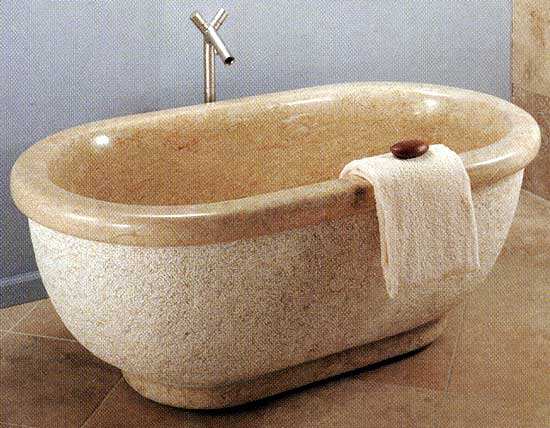
How Thermal Mass Affects Heat Retention in Stone Bathtubs
Density, Specific Heat, and Material Composition of Natural Stone
Thermal mass—the ability of a material to absorb, store, and gradually release heat—is central to the performance of stone bathtubs. Dense natural stones like granite, marble, and limestone excel due to their intrinsic physical properties:
- Specific Heat Capacity: Granite stores ~0.84 BTU/lb·°F; limestone holds ~0.72 BTU/lb·°F—meaning granite absorbs and retains more thermal energy per degree of temperature change.
- Density Impact: With densities ranging from 2.5–2.8 g/cm³ (e.g., granite at 2.65 g/cm³), these stones provide greater volumetric heat storage than lighter alternatives.
- Material Differences: Volcanic stones like basalt often outperform sedimentary types in thermal inertia due to tighter crystalline structures and lower porosity.
This combination allows stone bathtubs to stabilize water temperature over extended soaks—reducing or eliminating the need for reheating.
Porosity and Surface Sealing: Impact on Heat Loss in Stone Bathtubs
Unsealed stone loses heat through evaporation, conduction, and air movement within its pores. Key factors and mitigation strategies include:
| Factor | Effect on Heat Retention | Mitigation Strategy |
|---|---|---|
| High Porosity | Accelerates evaporative cooling | Penetrating sealants reduce moisture absorption by 60–80% |
| Micro-fissures | Create air pathways for convective loss | Professional polishing minimizes surface gaps |
| Uninsulated Bases | Conduct heat into cooler subfloors | Foam insulation panels improve retention by up to 22% |
When properly sealed and insulated, stone bathtubs slow heat transfer rates by up to 40% compared to untreated surfaces—extending soak duration while lowering energy use.
Stone Bathtubs vs. Common Alternatives: Heat Retention Performance
Acrylic, Porcelain, Copper, and Wood – Comparative Thermal Behavior
Material choice dictates thermal behavior—and ultimately, bathing comfort and efficiency:
- Stone bathtubs, with densities of 2,500–2,800 kg/m³ and specific heat capacities near 0.84 BTU/lb·°F (granite), retain water temperature 35–45% longer than acrylic or porcelain under identical conditions.
- Acrylic relies on air pockets in laminated layers for insulation but cools 1.5× faster than stone due to low thermal mass and thinner wall construction.
- Porcelain-enameled steel conducts heat rapidly, with water cooling up to 2°C per minute—nearly triple the rate of stone.
- Copper, with thermal conductivity of 401 W/m·K, dissipates heat 60–70% faster than stone despite its visual warmth.
- Wooden tubs, especially unsealed cedar, may offer brief thermal parity but risk accelerated cooling via moisture uptake and inconsistent density.
These differences translate directly to user experience: stone supports 50+ minute therapeutic soaks without reheating, whereas acrylic and porcelain typically require supplemental heating after 30–35 minutes—increasing hot water demand by 15–20% per session.
Real-World Implications of Heat Retention for Stone Bathtub Owners
Soak Duration, Comfort, and Energy Use in Residential Settings
Better heat retention turns regular baths into something more sustainable and actually good for the body. Stone tubs keep water warm around 60 minutes or so, which is about 35 to 50 percent longer than those cheap acrylic or porcelain models most people have. This means folks can relax longer without getting cold, and muscles tend to recover better when the water stays at a comfortable temperature. No sudden drops in warmth makes all the difference in comfort levels. Plus, since there's less need to keep adding hot water during a bath, each session saves roughly 25 gallons of water overall. Over months and years, this translates to lower energy bills for heating water too. So stone isn't just fancy looking stuff for rich folks anymore it actually makes sense from an energy standpoint as well.
Optimizing Heat Retention in Stone Bathtubs: Installation and Maintenance Tips
Proper Insulation, Subfloor Considerations, and Sealing Best Practices
Just having high thermal mass doesn't cut it by itself. How something gets installed and maintained makes all the difference in how well it actually works. Start with getting the subfloor right. Put down some closed cell foam or rigid board insulation under the tub to stop heat from leaking out into those colder parts of the house. If we're talking about freestanding tubs, lift them up on insulated pedestals so they don't sit directly on chilly floors. Then there's the issue of porosity. Once a year, slap on a penetrating sealer that can handle heat for both inside areas where water sits and outside surfaces too. This keeps things warm longer and stops water damage from happening over time. And don't forget about keeping the bathroom at least around 68 degrees Fahrenheit. Keep drafts to a minimum since cold air just steals away heat through convection. When done properly, these simple tricks help stone bathtubs stay warm, provide better comfort during long soaks, and save money on energy bills month after month.
FAQs
What factors affect the heat retention of stone bathtubs?
Factors such as density, specific heat capacity, porosity, and material composition influence the heat retention capabilities of stone bathtubs.
How does porosity affect heat retention in stone bathtubs?
High porosity accelerates evaporative cooling and convective heat loss. Using penetrating sealants can reduce moisture absorption by 60–80%.
Which alternative materials are used for bathtubs and how do they compare with stone?
Acrylic, porcelain, copper, and wood are common alternatives. Stone bathtubs retain heat significantly longer than these materials, offering better thermal performance.
What are the maintenance tips for optimizing heat retention in stone bathtubs?
Proper insulation, sealing with penetrating sealers, and maintaining a consistent bathroom temperature are key to optimizing heat retention.