 EN
EN

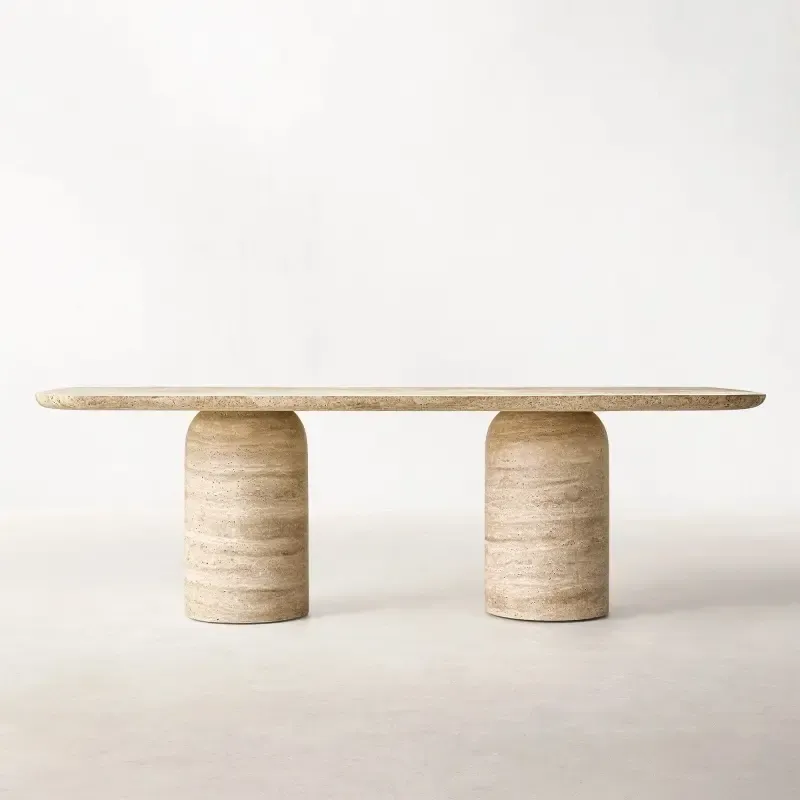
Understanding Travertine Grades and Quality for Tables
Commercial, Standard, and Premium Grades: What They Mean for Table Use
When selecting a travertine table, the stone’s grade is the single most important factor influencing durability and day-to-day performance. Travertine is classified into three distinct quality tiers—Commercial, Standard, and Premium—each with clear implications for furniture use. The table below summarizes their key differences.
| Grade | Filler Content | Visual Consistency | Best-Suited Table Application |
|---|---|---|---|
| Premium | Minimal, nearly invisible fill | Uniform color and veining | High-traffic dining tables, statement pieces where look and longevity are paramount |
| Standard | Moderate fill, slightly noticeable | Some color and veining variation | Coffee tables, side tables, or desks in moderate-use areas |
| Commercial | High fill, often mismatched color | Significant inconsistencies | Budget-friendly accent tables, outdoor settings, or rustic-style decor |
Premium-grade travertine, sourced from top-tier quarries, exhibits the fewest natural voids and most consistent mineral composition. Its dense, well-filled surface resists chipping and staining—making it ideal for dining tables subjected to daily meals, spills, and heavy objects. Standard grade balances cost and aesthetics, performing well in low-to-moderate use but showing wear sooner under frequent stress. Commercial grade, while affordable, carries the highest filler content and structural variability—traits that add character in garden or patio settings but compromise long-term integrity in primary indoor furniture. Always confirm the grade directly with your supplier; ambiguous labeling often masks lower-quality material.
Key Visual Indicators: Veining, Color Consistency, and Fill Integrity
The grade of a travertine table isn’t just a label—it’s legible on the surface. Begin by evaluating veining: premium slabs show delicate, organic, flowing patterns, whereas lower grades often display abrupt, fragmented lines that reflect less selective quarrying and cutting. Next, assess color consistency across the entire tabletop. A high-grade piece reveals only subtle tonal shifts; commercial-grade slabs may exhibit blotchy light-and-dark patches indicating inconsistent mineral deposition—a hallmark of less refined extraction. Finally, examine fill integrity. Natural pits and channels are filled with resin or cement; in premium tables, this filler is nearly invisible and precisely color-matched. In standard and commercial grades, the fill stands out—often with a different texture or off-white hue—and may feel uneven to the touch. Poorly filled depressions become dust traps and moisture reservoirs over time. Together, these visual cues form a reliable, real-world assessment of long-term resilience.
Choosing the Right Finish for Your Travertine Table
Honed, Polished, Tumbled, and Brushed: Performance Trade-offs for Table Surfaces
Travertine table finishes significantly influence both appearance and functional performance. A honed finish delivers a smooth, matte surface that effectively conceals minor scratches—ideal for high-use dining tables—but demands diligent sealing to resist stains. A polished finish offers a reflective, glossy aesthetic that’s easy to wipe clean but readily reveals etching and fine abrasions. Tumbled and brushed finishes provide textured, rustic appeal: tumbled edges are softly rounded and pitted, while brushed surfaces feature linear, lightly abrasive grain. Both excel at masking wear and enhancing slip resistance, though their irregular topography can trap debris and require more thorough cleaning. Ultimately, finish selection hinges on your tolerance for visible marks versus willingness to invest in routine maintenance. Regardless of choice, apply a penetrating sealer before first use and reapply annually—this is essential to protect travertine’s porous structure from coffee, wine, and acidic spills.
Verifying Authenticity and Structural Soundness in Travertine Tables
A beautiful travertine table is a statement piece—but its longevity depends entirely on what’s beneath the surface. The most critical distinction you can make is between solid stone and a thin veneer. This single factor dictates how the table will withstand daily use, impacts, and even the test of time.
Solid Stone vs. Veneer: How to Spot Low-Durability Construction
A solid travertine table is carved from a single, thick slab of natural stone, offering inherent durability and the ability to be refinished multiple times. In contrast, a veneer table wraps a thin layer (typically 1–3 mm) of travertine around a core of MDF, plywood, or honeycomb aluminum. While this approach reduces weight and cost, it introduces a fundamental weakness: the bond between stone and substrate. Internal testing by a leading manufacturer found that impacts causing only minor chipping on solid stone edges can trigger full delamination in veneer constructions—exposing the non-stone core and rendering the table irreparable. To verify authenticity, inspect the underside and edges: a continuous grain pattern wrapping seamlessly around the edge signals solid construction. A visible seam, sharp un-chamfered corner, or hollow “drum-like” sound when tapped strongly suggests veneer. Weight remains the clearest indicator—a genuine solid travertine table is notably heavy, a direct reflection of its dense, monolithic structure.
Managing Porosity, Staining, and Sealing for Long-Term Travertine Table Care
Why Travertine Tables Require More Frequent Sealing Than Granite or Quartz
Travertine’s natural vesicular (pore-filled) structure makes it significantly more porous than granite or quartz—directly impacting maintenance requirements. As shown below, sealing frequency and acid sensitivity differ markedly across common countertop and tabletop materials:
| Stone Type | Porosity | Recommended Sealing Frequency | Susceptibility to Acid Etching |
|---|---|---|---|
| Travertine | High | Every 1–3 years, or annually for heavy use | High (sealing reduces but does not eliminate) |
| Granite | Low to medium | Every 3–5 years | Low (some granites contain calcium that can react) |
| Quartz | Non-porous | None required | Resistant (engineered stone, no etching) |
Unlike non-porous quartz or denser granite, travertine’s calcium carbonate composition absorbs liquids rapidly—leaving it vulnerable to staining and moisture-related damage. Penetrating sealers fill microscopic pores, but the protective barrier degrades with use and exposure. Heavy-use dining tables typically require resealing every 6–12 months; lighter-use pieces may go 2–3 years. This proactive schedule is non-negotiable—not just for stain prevention, but because sealing is the only practical defense against irreversible acid etching.
Common Household Risks: Coffee, Wine, and Vinegar Exposure Test Results
Even with proper sealing, everyday acidic items pose serious risks to travertine. Red wine, coffee, and vinegar are especially damaging due to their low pH, which reacts directly with the stone’s calcium carbonate matrix. Controlled testing shows unsealed travertine develops visible etching within 30 minutes of red wine contact; sealed surfaces delay—but do not fully prevent—the reaction. Vinegar, with its aggressive acidity, can dull the surface almost instantly. Warm, acidic coffee penetrates pores quickly, leaving stubborn brown stains if not cleaned immediately. Always use pH-neutral cleaners and address spills without delay. Minor etching on sealed surfaces may be polished out, but deep stains often require professional restoration. Coasters, placemats, and consistent vigilance remain essential safeguards.
FAQ
What are the different grades of travertine and their use cases?
Travertine is classified into Premium, Standard, and Commercial grades. Premium has minimal filler and is visually consistent, making it ideal for statement dining tables. Standard works well for moderate-use furniture like coffee tables, while Commercial is suitable for budget-friendly or outdoor settings.
What visual indicators help identify travertine quality?
Key indicators include consistent veining, uniform color, and well-matched fill. Premium travertine shows organic patterns and nearly invisible filler, while lower grades may have inconsistent veining and noticeable fill discrepancies.
How does the finish of a travertine table affect its functionality?
Finishes such as honed, polished, tumbled, and brushed each offer unique characteristics. Honed surfaces are matte and conceal scratches well, while polished finishes are glossy but prone to etching. Tumbled and brushed finishes add texture but may require more maintenance.
What is the difference between solid travertine and veneer construction?
Solid travertine tables are carved from a single stone slab, ensuring durability and reparability. Veneer tables use a thin layer of travertine over a substrate, which reduces cost but compromises long-term durability and may delaminate with impact.
How often should a travertine table be sealed?
Sealing is crucial to prevent stains and damage. High-use travertine tables require sealing every 6–12 months, while lighter-use pieces may only need sealing every 2–3 years.
What are the risks of using acidic items on travertine?
Acidic items like coffee, wine, and vinegar can etch and stain travertine due to its calcium carbonate composition. Even sealed surfaces are not fully immune, so use coasters and clean spills promptly.
Table of Contents
- Understanding Travertine Grades and Quality for Tables
- Choosing the Right Finish for Your Travertine Table
- Verifying Authenticity and Structural Soundness in Travertine Tables
- Managing Porosity, Staining, and Sealing for Long-Term Travertine Table Care
-
FAQ
- What are the different grades of travertine and their use cases?
- What visual indicators help identify travertine quality?
- How does the finish of a travertine table affect its functionality?
- What is the difference between solid travertine and veneer construction?
- How often should a travertine table be sealed?
- What are the risks of using acidic items on travertine?